|
|
 |
|
 |
|||||||||||
 |
|
|
|||||||
|
 |
|
Why is it Necessary to Replace Hard Chrome?*
Chrome plating provides a very effective surface treatment for the reduction of wear, and in some cases corrosion. It has been in use for more than 70 years, and has proved to be a relatively cheap, effective solution. Over the past ten years HVOF coating technology has developed the point where it is widely available commercially. Equipment and powders are available from a number of suppliers, and the process is offered by aerospace-qualified job shops across North America, as well as elsewhere in the world. In general, it is found that the performance of HVOF coatings is far superior to chrome in wear, fatigue, and impact resistance, and is at least equal in corrosion resistance. Furthermore, the HVOF deposition process is faster than chrome (typically an hour or two versus 24 hours) and HVOF does not cause hydrogen embrittlement (which also eliminates embrittlement relief heat treatments). The consequent reduction of in-shop time makes many landing gear components significantly cheaper to coat by HVOF than by chrome plating. Even where HVOF is a more expensive process, its improved performance lowers the expected overhaul frequency, reducing the lifetime cost of ownership. On the basis of overall cost and performance, therefore, it makes sense to replace hard chrome with HVOF coatings. The environmental problem with hard chrome is not with chrome itself, but with the severe environmental problems associated with the plating process. Chrome itself is essentially inert, and is in fact safely used in everyday items such as stainless steel cutlery, and even inside the body in implanted prosthetic hips and knees. The primary problem lies with the hard chrome plating process, which uses a chromic acid solution, which the plating process releases into the air in the form of a fine mist. This mist contains chromium ions in the hexavalent (Cr6+) state, which has long been known to be carcinogenic and to cause a host of other medical problems, including perforated nasal passages and skin rashes. As a result, under the authority of the Clean Air Act, the EPA has recently promulgated new and more stringent rules to limit hexavalent chrome releases to the environment. These rules have increased the cost and complexity of hard chrome plating in many shops. Added to these rules, OSHA is expected soon to issue new regulations that will very seriously curtail the permitted levels of hexavalent chrome to which plating shop workers can be exposed. The limits, which are currently set at 100 micrograms per cubic meter, will almost certainly need to be reduced - perhaps to as low as 0.5 micrograms per cubic meter to reach the desired level of risk. The cost of reaching these levels will be very high - the National Defense Center for Environmental Excellence estimates $22 million for the first year and $46 million for each subsequent year, for the Navy alone. While the cost of chrome plating is rising to meet stricter standards, technologies developed over the last ten years have proved to be cleaner, more effective, and sometimes cheaper than chrome plating. Their superior performance is predicted to lead to significant reductions in life-cycle cost of ownership of military systems, while improving military readiness. As a result DoD has recognized the value of reducing its reliance on chrome plating. Components to be considered for HC replacement:
*reprinted from HCAT.org website http://www.hcat.org/replace_hc.html
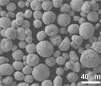
Inframat® HVOF feedstocks to be considered for HC replacement:
For more information please visit http://www.hcat.org/about.html
|
|||||||||||
Inframat Corporation
Tel: 860.553.6154 | Fax: 860.553.6645 | sales@advancedmaterials.us
Products | Services | Sponsored Research | SPS Equipment Home | About Us | News | Directions | Contact Us | Site Map | Careers |