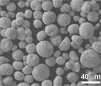
A catalyst is a substance that promotes the chemical reaction of other materials without becoming permanently involved in the reaction. In catalytic reactions, high surface area catalysts with nanoscale dimensions are of special interest in applications where active-site mediated chemical reactions play a decisive role. A limitation of today's active-site nanoparticulate materials is the strong tendency for the particles to form agglomerates, in which the intraparticle pore space becomes comparable with the particle size, i.e. nanoscale dimensions. This has the adverse effect of limiting the permeability of the reactive constituents into and through the agglomerated mass. To circumvent this problem, we have developed an enhanced percolation rate material, which is composed of a highly porous nanofibrous structure. A typical example is a chemically synthesized nanofibrous MnO2 bird's nest superstructure. The nanofibrous network is about 10 microns in size, and has an open-weave structure. The individual nanofibers have high aspect ratios and nanometer sizes.
This material can be used as a filtration media to be used in toxic volatile organic compounds ("VOC") removal in air and arsenic removal for drinking water.
|