|
| Inframat Magnetic Nanocomposite Research |
1. Introduction
Inductive components are extensively used in high frequency (> 1 MHz) electronic devices from radar, satellite, telecommunication systems to home radio stereos. Conventional inductive components use metallic alloys and ferrites as core materials. The major problem for metallic materials is their low resistivity (~10-6 W-cm). Since it is impossible to dramatically increase their resistivity, metallic materials were excluded in high frequency applications and ferrites have been the only choice for five decades since World War II. Although efforts have been made extensively to improve the performance of the ferrites, very limited progress was obtained. Magnetic materials have been a key impediment for the miniaturization of electronic equipment.
To overcome the difficulties of both metallic alloys and ferrites, Inframat® Corporation (“IMC”) is developing metal/ceramic nanocomposites for the next generation of high frequency magnetic applications. Nanocomposite processing has provided a new approach for fabricating soft magnetic materials. In a magnetic/ceramic nanocomposite, the resistivity can be drastically increased, leading to significantly reduced eddy current loss. In addition, the exchange coupling between neighboring magnetic nanoparticles can overcome the anisotropy and demagnetizing effect, resulting in much better soft magnetic properties than conventional bulk form materials.
IMC has developed innovative processes to facilitate microstructure of exchange coupled magnetic nanocomposite that retains nanograin size in the bulk-consolidated phase. This result is the first compelling evidence demonstrated in metal/insulator magnetic nanocomposites. This development has been done under contracts from NSF, NASA, DARPA, Airforce, and the US NAVY. Specifically IMC has demonstrated:
 |
- Chemical synthesis of Ni-Fe/SiO2, Co/SiO2, Fe-Co/SiO2, Fe/nickel-ferrite, Ni-Zn-ferrite/SiO2, Fe-Ni/ polymer, and Co/polymer magnetic nanocomposites
- Consolidate these magnetic nanocomposite powders into exchange coupled (>90% theoretical density) bulk components via vacuum hot press consolidation
- Consolidate these magnetic nanocomposite powders into exchange coupled (>90% theoretical density) bulk components via tape casting process
- Performance evaluation of the exchange coupled magnetic nanocomposite components
|
2. Commercialization Strategy
IMC is seeking corporate partner to prosecute the exciting opportunity to extend the lab results and implement in actual device as a part of an aggressive commercialization strategy.
3. Technology Development
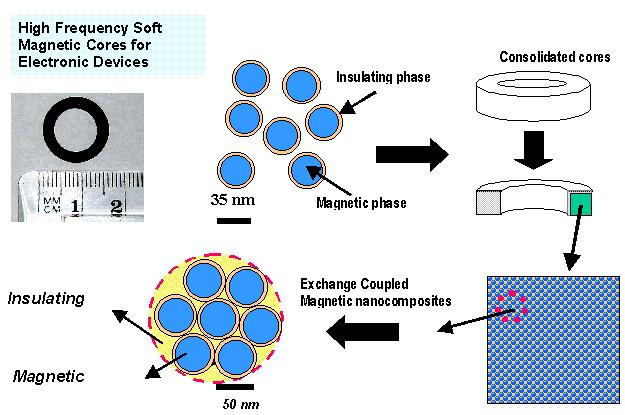
IMC’s technology for the synthesis and processing of metal/insulator magnetic nanocomposite is a radical departure from the conventional metallic and ferrite materials. A schematic of IMC’s magnetic nanocomposite technology is illustrated in Fig. 1, which includes powder synthesis (insulated coated magnetic nanoparticles), consolidation of the powder into exchange coupled cores. A completely new phenomenon has been observed when reducing the particle size and the separation between neighboring particles into a nanometer scale in composite matters. For example, it has been found that a Co- or Fe-based nanocomposite can possess a permeability much higher than that obtainable from the bulk Co or Fe metal. This large enhancement in permeability is due to the exchange coupling effect. The exchange interaction which leads to magnetic ordering within a grain also extends out to neighboring environments within a characteristic distance, the so-called exchange length lex. Thus, neighboring grains separated by distances shorter than lex can be magnetically coupled by exchange interaction. For a traditional powder material of large particle sizes, exchange coupling effect is negligibly small in determining magnetic properties. However, when the particle size plus the separation between particles is reduced to approximately lex, intergrain exchange coupling plays a dominant role and the material will possess a variety of properties different from the bulk size material. One important effect is the cancellation of the magnetic anisotropy of individual nanoparticles: when the particle-particle separation is significantly less than lex, the intergrain exchange interaction makes all the neighboring particles coupled. This coupling averages out the magnetic anisotropy of individual nanoparticles. As a consequence, the permeability of an exchange-coupled nanocomposite can be even much higher than the permeability of its bulk counterpart. |
Fig. 1. Schematic representation of Inframat’s magnetic nanocomposite technology |
|
Powder synthesis: IMC’s chemical synthesis route for metal/insulator nanocomposite magnetic materials provides a unique opportunity to modify the magnetic as well as electrical properties of the complex material in a rather large scale. For example, a nanocomposite consisting of a magnetic phase and an insulating phase such that the magnetic particles are embedded in the insulating matrix, the material now has essentially no overall electric conductivity. In addition, since the magnetic particle is in a nanometer size, the eddy current produced within the particle is also negligibly small. Therefore, conductivity of the magnetic constituent is no longer a factor in the material selection consideration and metallic materials can be used as magnetic phase.
IMC developed a nanocomposite technique suitable for massive production of bulk-size magnetic nanocomposite manufacturing. The synthesis procedures include (1) preparation of aqueous precursor solutions, (2) atomization of the precursor solutions to form a nanoparticle colloidal suspensions with maximal nucleation and minimal growth, (3) refluxing of the colloidal solution under controlled pH and time to form the desired microstructure and phases, washing and filtration, and low temperature calcination
IMC’s aqueous solution reaction technique is intrinsically low cost and scaleable to volume production. Utilizing the technique, we have successfully fabricated Co/SiO2 and Fe-Ni/SiO2 nanocomposite soft magnetic materials, which possess higher initial permeability and higher cut-off frequency than the conventional micrometer sized ferrites.
Nanocomposite consolidation: IMC’s current core consolidation steps include (1) preparation of ready-to-press powders, (2) consolidation of the ready-to-press powder into a green compact, (3) toroidal sample fabrication, and (4) low temperature annealing.
The consolidation of high density nanocomposite materials is a critical step towards development of an optimal soft magnetic material. An isolated nanocomposite particle possesses very high anisotropy due to its large surface anisotropy and demagnetizing effect. For nanocomposite materials, the soft magnetic properties come from the intergrain interaction, mostly due to the exchange coupling of the neighboring magnetic nanoparticles. The intergrain interaction tends to average the anisotropy of each individual particle, resulting in much reduced anisotropy and, consequently, higher permeability. A critical parameter, the exchange coupling length, is the distance within which the magnetic moments of the two particles can be coupled. For Co and Fe, the exchange length is estimated to be ~35 nm. Thus, the particles have to be consolidated to achieve separation of the neighboring particles that are less than the exchange length.
Thick film fabrication: IMC is developing a coating formulation (or paste) that can be screen printed for thick film magnetic circuit board applications. Here, polymer coated magnetic colloidal nanoparticles are prepared in organic or aqueous solvents. Suitable surfactants are added to the solutions to assess potential benefits for achieving optimal homogeneity of dispersed magnetic nanoparticles. After screen printing, the materials are then cured to form high packing-density thick film.
IMC is currently exploiting a sputtering technique for the fabrication of both thin and thick film magnetic nanocomposite materials. In the case of a thin film, multilayered structure of magnetic/nonmagnetic layers will be resulted. The thickness of the layer is limited to be < 100 nm. The resultant multiplayer thin is suitable for GMR devices.
In the case of thick film, granular magnetic particles are uniformly coated with a thin layer of insulating nonmagnetic phase. The thickness of the film can be up to 50 mm. The resultant thick film will be suitable for high frequency power converters (e.g., >30 MHz), and microwave (>1 GHz) and millimeter wave (>15 GHz) radar applications.
Tape Casting consolidation: IMC’s tape casting approach seems to be a very effective way to process large volume magnetic nanocomposite components for high quality device applications. Unlike conventional tape casting techniques, IMC’s technique involves the addition of chemical precursors to the slurry composition to promote low temperature sintering so that high density with minimal grain growth had resulted in the sintered components.
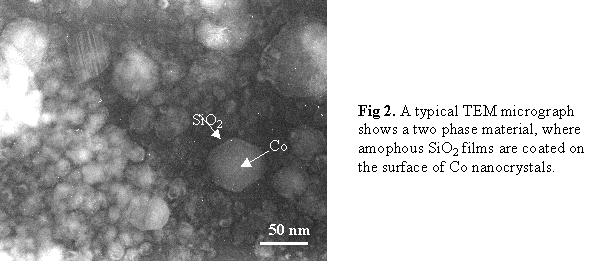
Nanocomposite properties: A typical TEM bright field image for IMC’s synthetic n-Co/SiO2 is shown in Fig. 2. It reveals that the nanocomposite is a two-phase material, where the Co magnetic nanoparticles are coated with a thin film of silica. The Co phase has an average particle size of ~30 nm. Selected area electron and x-ray diffraction experiments indicated that the Co particles are fcc nanocrystals, where the matrix silica phase is amorphous. |
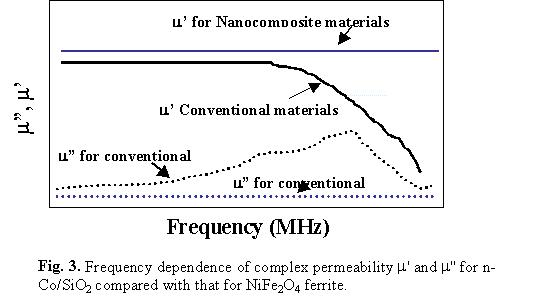
High frequency applications require magnetic materials with large m¢ and large Q, while keeping m¢¢ minimal. The currently used ferrites, including spinel ferrites ((Ni,Zn)2Fe4) and hexagonal ferrites (Co2Z, where Z = Ba3Me2Fe24O41), have a m¢ value < 15, and the cutoff frequencies (the frequency at which Q £ 1) are less than 500 MHz.
Fig. 3 shows a schematic representation the frequency dependence of m¢ and m¢¢ for the nanocomposite in comparison with conventional magnetic materials. Compared with conventional magnetic materials, IMC’s magnetic nanocomposite shows a flat frequency response, with minimal core loss agains all frequency, while conventional magnetic materials exhibited high losses at elevated frequencies. General speaking, the advantage of magnetic nanocomposite include, (1) reduction in total core power losses, (2) the high flux capabilities at elevated temperatures that the nanocomposite cores are expected to support, thereby enabling manufacture of smaller power devices, and (3) broadband devices. IMC's breakthrough technology in nanostructured magnetic components will be extremely attractive to reduce the cost and size of the current magnetic components. |
4. Background and Applications
There has been a great deal of interest in recent years in artificially engineered nanomaterials with novel physical properties. Among the researches, perhaps the effort in magnetic nanostructures attained the biggest rewards to date. These achievements imply a brilliant prospective of nanomagnetics.
4.1. What makes nano-magnetics so unique?
Spin memory: For conventional materials with dimensions much longer than the spin diffusion length of electron, which is in a scale of 10 nm, an electron flips its spin direction up and down many times in the path, thus the effect of spin direction on material’s resistivity is time-averaged out. However, when reducing the dimension of the building block unit of a material to the same scale, the spin of electron remains unchanged when passing through the unit. In this case, the electron current is characterized not only by its charge current, but also by its spin current. In macroscopic world, the electron spin plays as a concept, its existence can only be felt indirectly except in some special fundamental experiments. In nano-world, electron spin becomes a real thing. It can be seen directly; it can be engineered and utilized. Nano-magnetics is quickly bringing electron spin explicitly into ordinary people’s daily life.
Spin-dependent transport characteristics: Taking electric resistivity as an example. For transition metal magnetic materials, the s-d scattering is the major contribution to electrical resistivity of these materials, and the scattering is very much dependent on the relative orientation between the electron spin moment and the 3d atomic moment. When electrons travel in a magnetic metal, the resistivity for the electrons with spins parallel to the magnetization of the metal is different from that for the electrons with spins antiparallel to the magnetization. For conventional materials with dimensions much longer than the spin diffusion length, the effect of spin orientation on the resistivity is time-averaged out in its long distance journey. However, when the dimension of the material is comparable to the spin diffusion length, the spin-dependent resistivity behavior is well pronounced. In this case, the resistivity is subjected to a large change when the magnetic state of the material is varied by an applied magnetic field. It is so called giant magnetoresistive (GMR) effect as it was found that such magnetoresistive effect in nanomagnetic materials is of 10 times larger in magnitude than in macroscopic materials. Based on the similar mechanism, other transport effect also subjected to giant variations.
Exchange coupling: The quantum mechanics rooted exchange interaction exists not only within the building block unit of a magnetic material (which leads to the magnetic ordering of the atomic moments within the entity), but also extend to neighboring units. The later is called exchange coupling. For the currently used (conventional) magnetic materials, their building block unit, grain, is in micron scale; the exchange coupling is negligibly small compared with the macroscopic thermodynamic interactions within each grain. Thus their macroscopic properties are determined by macroscopic thermodynamic rules within each grain. When reducing the scale of the entity to a few nanometers or so, the exchange coupling is comparable or even greater than the thermodynamic interactions; the grains will be exchange coupled to each other. In this case, the individual grains losses their classical characteristics, and new magnetic structures and new magnetic properties can be created. The rules governing magnetic properties are different
4.2. What does (or will) small-size bring to magnetics?
Spin electronics: The name of spin electronics (also called spintronics or magnetoelectronics) was appeared first in 1995. Taking electron spin as information carrier, spin electronics engineers attaining net spin current, transporting and detecting spin signal, integrating spin signal with electron charge signal and the related physics. The major advantages of spin electronics devices are (i) high sensitivity, (ii) miniaturization, (iii) high operation speed, and (iv) low power consumption. As to the prospective of spin electronics, if recalling what photonics has played in science and technology when electron is combined with photon, one would expect the same, if not more, from spin electronics when electron charge is combined with electron spin.
Revolution in magnetism: For conventional materials, grain is the elementary unit; the ferromagnetism is determined by the domain and domain wall structure in the grain. In nanostructured magnetic materials, the grain is just like a point with giant moment. The ferromagnetism is governed by the intergrain exchange interaction. Thus the magnetic structure, static and dynamic magnetic behavior of nanomagnetic systems are different from those for conventional magnetic materials. With the creation of nanomagnetic systems, magnetism is now heading for a new generation.
Novel magnetic materials with better magnetic properties and new functionalities: In less than 15 years, a lot of nanostructured magnetic materials and devices have been developed or in progress. Following are some examples.
|
(1). Spin electronics materials and devices, including (i) GMR read head devices, (ii) magnetic random-access-memory devices, (iii) nanostructures for sensors, and other low dimensional nanostructures such as multilayers, nanowires
(2). Magnetic recording media, such as granular thin films and arrays
(3). Function materials, including (i) nanocrystalline soft magnetic alloys (such as Fe-Cu-Nb-Si-B), (ii) nanocomposite high frequency soft magntic thin films (such as Fe-Co-Zr-O), (iii) exchange coupled hard magnetic materials (such as Nd2Fe14B/Fe3B). |
In summary, nanomagnetic materials drive one more physical quantity, electron spin, to the front stage as a major player; they change major interaction in the material; they brings extra degrees of freedom to the magnetic materials science. Magnetics is experiencing a revolutionary progress. Recognized such enormous opportunities, Inframat Corporation is moving ahead to catch the strength.
4.3. Inframat’s Vision in Magnetic Nanocomposites
Nanocomposite soft magnetic materials: The electronics industry is directed towards high frequency of operation, which in turn requires bulk sized high frequency soft magnetic materials. Conventionally used ferrites possess poor magnetic properties at elevated frequencies. According to IMC’s metal/insulator nanocomposite design, the metal nanograins are insulated by insulating layers, thus the resistivity of the system will be dramatically increased, leading to a significantly reduced eddy current loss, while the exchange coupling between neighboring magnetic nanoparticles can overcome the anisotropy and demagnetizing effect, resulting in much better soft magnetic properties than conventional ferrites. This design provides more degree of freedom (phase constituents, their ratio and grain size) to tailor magnetic as well as electric properties. We have been studying several metal/insulator systems to meet various requirements.
Planar magnetic devices: The Development of high quality nanostructured soft magnetic materials make it possible to miniaturize magnetic devices and integrate them in circuit board. We pan to develop thin film technique to fabricate high frequency metal/insulator nanocomposite films and devices for DC-to-DC applications.
Magnetic sensors: In addition to computer related areas, spin electronic devices have an enormous potential in sensor technology. The high sensitivity, low power consumption, small size and large tolerance of spin electronics devices make them ideal for sensor. We plan to explore spin valve based GMR sensors for a variety of applications.
|
|